
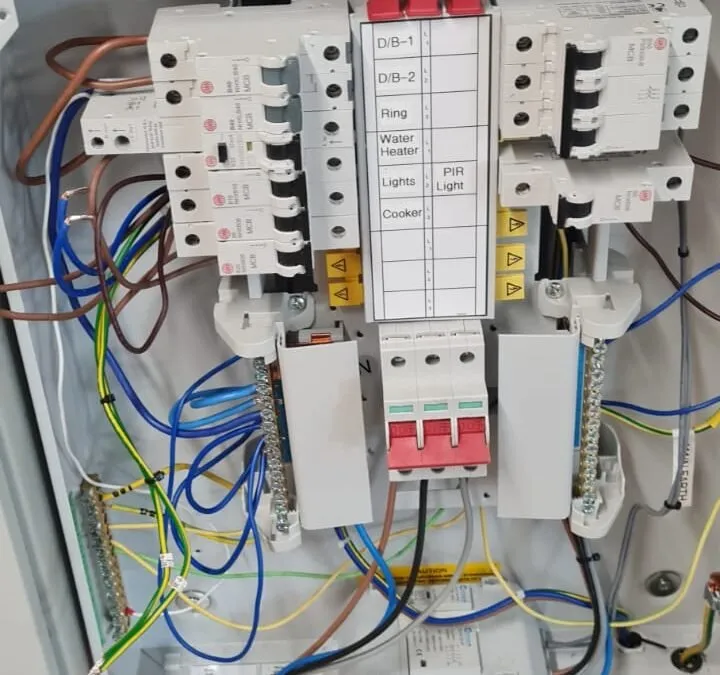
When choosing a new fuse board or upgrading an existing consumer unit, one of the most important decisions is selecting the right electrical protective devices.
You may have heard electricians mention MCBs, RCDs, RCBOs, surge protection devices (SPDs) and arc fault detection devices (AFDDs). These components perform different functions, and understanding their differences can help homeowners, landlords and businesses make informed decisions.
A modern consumer unit should be designed around the electrical installation it serves. The number of circuits, type of equipment, existing wiring, supply characteristics and relevant safety requirements all affect the choice of protective devices.
At BuildSpark, we provide professional electrical installation services across South West London, including consumer unit replacements, electrical testing and fault finding.
This guide explains the main types of electrical protective devices, compares different consumer unit arrangements and outlines what to discuss with your electrician before choosing a fuse board.
What Are Electrical Protective Devices?
Electrical protective devices are components designed to disconnect electricity or limit certain electrical hazards when abnormal conditions occur.
Different devices protect against different problems.
For example, an MCB protects a circuit against excessive current, while an RCD detects an imbalance between the current flowing through live conductors.
A surge protection device serves another purpose: limiting transient overvoltages that could damage connected electrical equipment.
No single device provides every type of electrical protection.
Why Is the Correct Combination Important?
Electrical installations need suitable protection against hazards such as:
-
Overloads and short circuits.
-
Earth faults and electric shock.
-
Transient overvoltages.
-
Certain types of dangerous electrical arcing.
-
Faults affecting individual circuits.
The correct protective arrangement depends on the installation design and applicable requirements of BS 7671, the UK Wiring Regulations.
MCB vs RCD vs RCBO vs SPD: What's the Difference?
The following comparison explains the main purpose of each device.
| Device | Full name | Main function |
|---|---|---|
| MCB | Miniature Circuit Breaker | Protects against overloads and short circuits |
| RCD | Residual Current Device | Detects residual current and disconnects the supply under specified conditions |
| RCBO | Residual Current Breaker with Overcurrent Protection | Combines residual-current and overcurrent protection |
| SPD | Surge Protection Device | Limits transient overvoltages |
| AFDD | Arc Fault Detection Device | Detects certain types of potentially dangerous electrical arcing |
These devices are not interchangeable. Their selection must account for the installation and the manufacturer's specifications.
1. What Is an MCB and How Does It Work?
An MCB is a Miniature Circuit Breaker.
It protects an electrical circuit against excessive current caused by an overload or short circuit.
For example, if too much electrical load is connected to a circuit, the MCB may disconnect the supply to protect the wiring.
What Does an MCB Protect Against?
An MCB is designed to provide overcurrent protection.
It does not, by itself, provide the additional residual-current protection associated with a 30 mA RCD.
What Do B, C and D Mean on an MCB?
MCBs are available with different tripping characteristics.
Type B: Commonly used in domestic installations, depending on the circuit design.
Type C: May be appropriate for circuits with higher starting currents, where the installation conditions permit.
Type D: Used for certain specialised applications with high inrush currents.
The correct type must be selected through electrical design and verification, not simply because a particular appliance causes nuisance tripping.
Can You Replace an MCB With a Higher-Rated One?
You should never increase an MCB rating simply to stop a circuit tripping.
The protective device must be appropriate for the cable, installation conditions and fault characteristics.
An incorrectly selected breaker could leave wiring inadequately protected.
If your circuits repeatedly disconnect, read our guide to why your fuse board keeps tripping.
2. What Is an RCD and Why Is It Important?
RCD stands for Residual Current Device.
An RCD monitors the balance of current flowing through the relevant live conductors.
If it detects a residual current above its operating threshold, it is designed to disconnect the supply within specified conditions.
RCDs can provide important additional protection against electric shock and reduce risks associated with certain earth faults.
Does an RCD Protect Against Overloads?
An ordinary RCD does not provide overcurrent protection.
It must be used with suitable overcurrent protection where required.
This is one of the key differences between an RCD and an RCBO.
What Is a 30 mA RCD?
A 30 mA RCD is commonly used to provide additional protection in many electrical installations.
However, an RCD does not eliminate every electric shock risk. For example, it may not detect a fault where current flows between line and neutral without a residual-current imbalance.
What Is the Difference Between Type AC and Type A RCDs?
RCDs are classified according to the residual-current waveforms they are designed to detect.
Type AC devices respond to sinusoidal alternating residual currents.
Type A devices also respond to specified pulsating direct residual currents.
Modern electronic equipment can affect RCD selection, so the appropriate device type must be assessed for the connected loads.
Other RCD types are available for specialised applications.
An electrician should select the appropriate type rather than automatically fitting the same device to every circuit.
3. What Is an RCBO?
RCBO stands for Residual Current Breaker with Overcurrent Protection.
An RCBO combines two functions in one device:
-
Overload and short-circuit protection.
-
Residual-current protection.
This makes it possible to provide both functions to an individual circuit without relying on a separate shared RCD.
What Are the Advantages of RCBOs?
One of the main advantages is improved separation between circuits.
For example, if a fault occurs on a kitchen socket circuit protected by its own RCBO, the fault may disconnect that circuit without disconnecting other healthy circuits.
This can help reduce inconvenience and make fault identification easier.
Are RCBOs Better Than MCBs?
They perform different functions.
An MCB provides overcurrent protection, while an RCBO combines overcurrent and residual-current protection.
Where both types of protection are required, an RCBO may provide a practical solution.
However, the suitability of any device depends on the electrical design.
Does Every Circuit Need an RCBO?
Not automatically.
The correct protective arrangement must comply with the applicable requirements and account for the installation's circumstances.
Individual RCBOs are a common design choice for modern domestic consumer units because they can improve circuit separation.
4. What Is an SPD in a Consumer Unit?
SPD stands for Surge Protection Device.
An SPD is designed to limit transient overvoltages that can arise from events such as lightning-related disturbances or electrical switching.
These voltage spikes may damage sensitive electronic equipment.
What Equipment Can Benefit From Surge Protection?
Surge protection may help reduce the risk of damage to equipment such as:
-
Computers and televisions.
-
Broadband routers and networking equipment.
-
Smart-home systems.
-
Electronic heating controls.
-
Appliances containing electronic components.
-
Other sensitive electrical equipment.
An SPD does not guarantee that connected equipment will survive every electrical disturbance.
Is Surge Protection Mandatory in UK Homes?
BS 7671 contains requirements for assessing and providing protection against transient overvoltages.
Whether surge protection is required, and what arrangements are appropriate, depends on the circumstances and the applicable edition of the regulations.
It should not be assumed that every existing home without an SPD automatically needs a complete consumer unit replacement.
Can an SPD Be Added to an Existing Consumer Unit?
Sometimes.
Whether this is practical depends on the existing equipment, available space, manufacturer compatibility and installation design.
A qualified electrician should assess the consumer unit before recommending an addition or replacement.
5. What Is an AFDD?
AFDD stands for Arc Fault Detection Device.
An AFDD is designed to detect certain electrical arcing conditions that conventional overcurrent and residual-current devices may not identify.
Electrical arcing can occur because of damaged conductors, loose connections or other defects.
Are AFDDs Required in Every Home?
No.
BS 7671 specifies particular situations where AFDDs are required and other circumstances where they may be recommended.
Requirements depend on the installation type, circuit and applicable regulations.
An electrician should assess the specific installation rather than suggesting that every domestic circuit must have an AFDD.
Does an AFDD Replace an RCD or MCB?
Not necessarily.
AFDD functionality may be incorporated into devices offering other protective functions, but the complete protective arrangement must still satisfy the installation's requirements.
Dual-RCD vs High-Integrity vs Full-RCBO Consumer Units
Consumer units can be configured in different ways.
The arrangement affects circuit separation, fault behaviour, maintenance and cost.
| Consumer unit type | Arrangement | Main consideration |
|---|---|---|
| Dual-RCD | Groups of circuits protected by shared RCDs | One fault may disconnect several circuits |
| High-integrity | Combination of shared RCD protection and individually protected circuits | Offers greater flexibility |
| Full-RCBO | Individual RCBO protection for circuits | Improved circuit separation and easier fault identification |
Dual-RCD Consumer Units
A dual-RCD board commonly divides circuits between two RCD-protected groups.
This arrangement has been widely used in domestic installations.
However, a fault affecting one shared RCD can disconnect multiple circuits.
High-Integrity Consumer Units
A high-integrity arrangement can provide individually protected circuits alongside groups protected by shared RCDs.
The exact configuration depends on the board and protective devices used.
Full-RCBO Consumer Units
A full-RCBO board provides individual residual-current and overcurrent protection for its circuits.
This can reduce the likelihood of one circuit fault disconnecting unrelated circuits.
However, the design still needs to account for the installation's characteristics and applicable requirements.
Which Consumer Unit Is Best?
There is no single board configuration that is automatically best for every property.
For many modern domestic installations, individual RCBO protection can offer practical advantages.
However, the correct decision should follow an assessment of the existing wiring, number of circuits, protective requirements, budget and future electrical needs.
How Many Ways Should a Consumer Unit Have?
A consumer unit's number of ways refers to the available positions for outgoing circuit protective devices, although the space required by individual components varies.
The correct size depends on the electrical installation.
Consider Your Existing Circuits
A property may have separate circuits for lighting, sockets, cooking equipment, electric showers, heating or other loads.
An electrician should identify the existing circuits rather than estimate the required board size solely from the number of rooms.
Plan for Future Electrical Work
It can be sensible to consider future requirements, such as:
-
Additional kitchen circuits.
-
A home extension.
-
An electric vehicle charging point.
-
Outdoor electrical installations.
-
Electric heating equipment.
-
Future circuit alterations.
Leaving suitable capacity may reduce the need for further changes later.
However, spare capacity must be planned alongside the board's physical dimensions, electrical loading and manufacturer requirements.
Does a Consumer Unit Need a Metal Enclosure?
Current UK requirements for consumer units in domestic premises include provisions concerning non-combustible enclosures.
Metal enclosures are commonly used to meet these requirements.
However, an existing plastic consumer unit does not automatically become dangerous simply because it was installed before current requirements applied.
The condition, location and protective arrangements must be assessed.
If you're unfamiliar with the overall function of a fuse board, read our separate consumer unit safety guide for UK homeowners.
Can You Mix Protective Devices From Different Manufacturers?
Protective devices should not be mixed within a consumer unit without confirming that the combination is approved and suitable.
Even where devices appear physically compatible, differences in dimensions, busbar connections and performance can create problems.
The consumer unit and protective devices must be installed in accordance with the relevant design and manufacturer instructions.
An electrician should verify compatibility rather than assuming that every breaker fitting onto a DIN rail is suitable.
Do Older Fuse Boards Need Replacing?
Not every older fuse board requires immediate replacement.
An installation may have been compliant with the requirements applicable when it was installed.
The important question is whether the equipment remains safe and suitable for continued use.
Reasons an Upgrade May Be Recommended
A replacement may be appropriate where an assessment identifies:
-
Damaged or deteriorated equipment.
-
Unsafe connections or overheating.
-
Inadequate protective arrangements.
-
Defects that cannot reasonably be corrected within the existing board.
-
A need for new circuits or substantial installation changes.
-
Equipment that is unsuitable for the intended installation.
The decision should be based on inspection and technical assessment, not simply the property's age.
Does a Failed EICR Mean You Need a New Fuse Board?
Not necessarily.
An unsatisfactory EICR may identify defects that can be repaired without replacing the entire consumer unit.
Where a board replacement is necessary, the electrician should explain why.
For further guidance, read about remedial electrical work following an unsatisfactory EICR.
What Should an Electrician Check Before Replacing a Fuse Board?
A consumer unit replacement requires assessment of the existing electrical installation.
The electrician should consider matters such as:
-
Supply characteristics and earthing arrangements.
-
Main protective bonding.
-
Existing circuit condition.
-
Cable sizes and protective-device suitability.
-
Insulation resistance and relevant test results.
-
Circuit identification.
-
Prospective fault current.
-
Existing installation defects.
-
Available space and accessibility.
-
Requirements for additional protection and surge protection.
Any issues affecting the proposed work should be explained before the installation proceeds.
What Certificates Should Be Provided?
Consumer unit replacement normally requires appropriate electrical installation inspection, testing and certification.
In England, replacing a consumer unit in a dwelling is generally notifiable under the Building Regulations.
Where applicable, the appropriate Building Regulations compliance documentation should also be arranged.
BuildSpark provides professional fuse board upgrades and consumer unit replacements in London.
Frequently Asked Questions About Fuse Board Protective Devices
What Is the Main Difference Between an MCB and an RCBO?
An MCB provides overload and short-circuit protection.
An RCBO combines overcurrent protection with residual-current protection.
Is an RCBO the Same as an RCD?
No.
An RCD detects residual current but does not ordinarily provide overload and short-circuit protection.
An RCBO combines both protective functions.
Should I Choose a Full-RCBO Consumer Unit?
A full-RCBO arrangement can provide useful circuit separation and reduce disruption from faults affecting individual circuits.
Whether it is suitable depends on the installation design.
Do I Need Surge Protection in My Fuse Board?
The requirements depend on the installation and applicable BS 7671 provisions.
An electrician should assess whether surge protection is required and how it should be provided.
Can I Replace a Circuit Breaker Myself?
Consumer unit work involves significant electrical hazards.
Protective devices must be correctly selected, compatible with the equipment and appropriately installed and tested.
This work should be undertaken by a competent electrician.
Will a New Consumer Unit Stop My Electrics Tripping?
Not necessarily.
Tripping may be caused by defective appliances, damaged wiring, overloads or other faults.
Replacing the consumer unit without identifying the cause may not resolve the problem.
Do Landlords Need RCBO Consumer Units?
There is no universal requirement that every rented property must have a full-RCBO consumer unit.
The installation must meet applicable electrical safety requirements, and any identified defects must be addressed appropriately.
Does BuildSpark Install Consumer Units With RCBO and Surge Protection?
BuildSpark provides consumer unit replacement and electrical installation services across South West London.
The protective devices and board configuration are selected according to the installation's requirements.
Why Choose BuildSpark for Consumer Unit Upgrades?
BuildSpark is a NAPIT-registered electrical contractor serving homeowners, landlords, HMOs, letting agents and businesses across South West London and Surrey.
Our services include consumer unit replacements, electrical testing, fault finding, installation improvements and remedial electrical work.
We can assess the existing installation, explain the available protective arrangements and provide a quotation for suitable work.
Need Advice About Your Fuse Board?
Unsure whether your property needs RCBO protection, surge protection or a consumer unit upgrade?
BuildSpark provides professional electrical services across Tooting, Balham, Wimbledon, Wandsworth, Clapham, Streatham and surrounding areas.
Call: 0203 488 7378
WhatsApp: Message BuildSpark
Free quotation: Request your BuildSpark quote
Online booking: View BuildSpark electrical services